A State of Me, and What’s Next
On how the work kept scaling, what it’s all for, and the threads I’m pulling next.
How the work kept scaling
Seven years ago, when I started as a trainee decision scientist, I was working with a client — a 400-year-old construction management company — trying to predict monthly budget requirements for their projects. It sounded like a meaningful, high-impact problem. But the day-to-day reality, especially in the beginning, was much simpler. It was one CSV file, roughly 300 MB, and weeks spent cleaning data, building analytical datasets, creating features, and experimenting with models like RNNs and boosting methods. There were graphs, metrics, hyperparameter tuning — and at that stage, all of it felt exciting.
That excitement came from the feeling that we were “doing data science.” Building models, generating insights, making numbers move. Progress, to me then, looked like learning a few more algorithms or picking up techniques from blogs and online threads. It was very workflow-centric, very model-centric.
Over time, that framing started to break.
The shift wasn’t sudden, but it was deep. Problems stopped looking like “take this dataset and build a model,” and started looking like systems. What is the actual decision being made? What constraints shape it? What abstractions are missing? What kind of system should exist around this problem?
Today, I operate much more at that level. I find myself owning problems end-to-end — from how a user interacts with a system, to how decisions are structured and evaluated, down to how agents or services communicate, what protocols they follow, and how the underlying code behaves at a granular level. It spans interfaces, decision logic, system design, and implementation details.
From the outside, that breadth can sometimes look unfocused. But in practice, it has been the opposite. It’s a way of engaging deeply with meaningful problems across dimensions — engineering, product thinking, research, and even the human side of how systems are used and understood.
A big part of this shift came from stepping outside predefined paths. I never followed standard roadmaps or built my trajectory around what a role expects next. Instead, I built my own way of thinking and working — shaped by problems, by experience, and by ideas that stayed with me.
None of this happened the way careers are supposed to happen. It didn’t come from courses, or from the rhythm of a Jira board feeding client meetings feeding performance reviews. It certainly didn’t come from collecting stars — titles, badges, the next visible marker. What actually moved me was quieter and harder to point to: reading widely, and studying how the best builders and organizations solved their problems — how enterprises structure themselves, how flat tech companies move, how research labs frame questions others haven’t thought to ask. Out of all of it, I kept building and rebuilding mental models.
The influences that mattered came less from structured learning and more from thinkers and builders — Kahneman, Thaler, Gladwell, Brian Arthur, and people I worked with early on. What stayed with me wasn’t their techniques but their ways of reasoning about decisions, systems, uncertainty, and behavior. Over time I realized that what I’d actually learned wasn’t methods at all — it was how to learn, how to think, and how to operate.
And something strange happens when you do this long enough. You start reinventing concepts on your own — arriving at an idea through your own exploration, only to find later that others had reached it too. That convergence isn’t discouraging; it’s verification. It tells you you’re exploring in the right direction. The reading, the thinking, the building, and the problem-solving stop being separate activities and start reinforcing one another. There’s an emergence to it.
Over time I’ve come to hold a kind of map of all this — a sense of where I am, where I’m heading, what a better path forward might look like, what I still need to learn. My background in control and decision systems probably shapes how I see it: I think of myself a little like a decision process, where each state I’m in is a compression of the entire trajectory that got me there. That framing takes the pressure off. The goal was never to know everything at once — it’s to keep the next step figure-out-able. Solvable. Learnable. Even as the scope keeps growing.
Because scaling isn’t just doing more of the same. It’s trusting that if you keep reading, thinking, building, and solving, there will be emergence. There will be reinvention. There will be a reconciliation of threads that once looked unrelated. You build the capability, and you trust the process to compound.
My time at Columbia pushed this further. It gave me the environment to go deeper into research areas like causal inference, representation learning, world models, and decision-centric AI, while still grounding that thinking in real systems. It helped connect threads that once felt separate — engineering, research, and decision-making — into a more coherent direction.
That’s where the work becomes multidimensional. You’re no longer fitting into a job description or following what a paper prescribes. You’re asking what kind of problems you want to own — and what kind of thinker and builder those problems require you to become.
And with that comes a quieter shift. Early on there’s a nagging sense that you’re missing something — another framework, another trend, another signal from the market. That anxiety fades once you realize you’ve built the ability to figure things out and operate across unfamiliar spaces. It’s liberating, because it moves your dependence away from roles and markets and toward capability. Markets change. Titles change. Demand shifts. But meaningful problems continue to exist — and if you’ve built yourself around solving them, you’re not constrained by any single definition of what your role should be.
Looking back, the biggest change isn’t just in skill or experience. It’s in scale — of thinking, ownership, and direction.
From working on a single dataset
to thinking in systems.
From executing tasks
to defining problems.
From following paths
to creating one.
And somewhere along the way, the work stopped being about “doing data science” — and became about understanding and shaping how systems think, decide, and evolve.
So what is it all for?
But scale is not the same as purpose. Scale is about how far your thinking reaches. Purpose is about what it’s for. And if I’m honest, that second question is the one that has only recently come into focus.
It’s been about ten months now since this master’s journey in the US began — with a fair share of ups and downs. And this is the first time I’ve felt this much clarity. Not the clarity of having figured everything out, but the clarity of being able to think long-term again, to see the shape of the whole thing rather than just the next step. The core intention hasn’t actually changed. If I went back and read what I wrote years ago, the crux would be the same. What’s changed is that it’s sharper now, with the noise reduced. Ecosystems have a way of nudging you toward the conservative, the narrow, the performative — a kind of fake productivity. Cutting through that is, I think, the real progress.
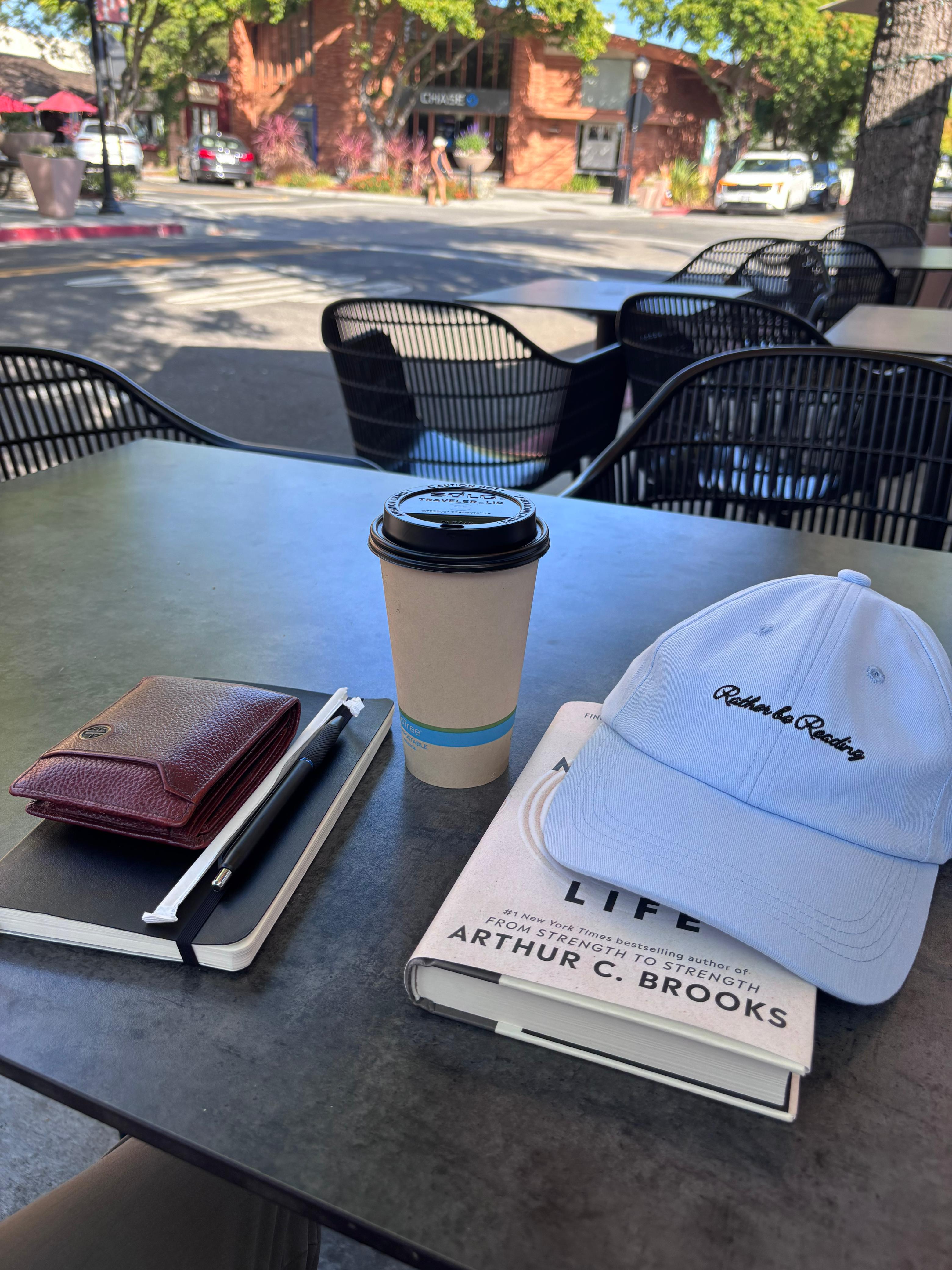
Some of that clarity has come from outside, too. Arthur C. Brooks’s The Meaning of Your Life gave me a steadier way to sit with the emptiness and dissatisfaction that surface whenever you’re between things — a reminder that the confusion isn’t a detour from the work, but part of how you find out what the work is for. If someone asked me today what to read, that’s the book I’d hand them.
So let me try to say what the purpose actually is. It helps to start with what it is not.
It is not “I know CUDA, so I’ll optimize kernels.” It is not making the GPUs go brrr, or token-maxing, or code-maxing. It is not picking whatever happens to be relevant this season — continual learning sounds cool, so I’ll stay visible on continual learning — and being performative about it. Those are all real skills, and I’m genuinely interested in them. But they live on a single, flat dimension, and I don’t want to be reduced to it.
The purpose sits at a different altitude. The closest I can come to naming it is this: I want to share problem-solving journeys on problems that matter.
That framing carries a lot for me. It means that if someone wants to assess me, or invest in me, or work with me, I’d want that to happen through the value of a shared problem-solving journey — something mutually figured out — rather than two hours of asking whether I can invert a binary tree. I’m still happy to do the technical proof; that’s not the issue. The issue is being evaluated on one narrow slice of a much larger surface. What I’m actually good at only shows up across dimensions — from the top-level product a person touches, all the way down to how a single service is wired and behaves. That’s the same breadth I’ve been describing this whole time; it’s just that now I know what it’s for.
And the purpose lives at different scales.
As an individual and a student, it’s a way of staying honest about why I’m doing any of this — not to collect another framework, not to buy time, but to keep expanding how I see the world, the problems in it, and myself.
For others on a similar path — incoming students, people looking for a sound thought to hold onto, people who’ve walked something like this or who see it completely differently — I’m writing it down partly because I’d have wanted to read something like it.
For teams and companies looking for the right person, it’s an invitation to a particular kind of relationship: reducing friction, shortening the time from a hard problem to a real resolution, and helping people solve more hard problems than they otherwise could.
And for the world — this is the part I once tried to explain to my mom. I told her I’m learning to make machines think, and work, a little more like humans. Where that leads, I genuinely don’t know yet, and I like that I don’t. It might be helping labs grow meat. It might be somewhere in the frontier of biology and medicine — the kind of work that ends with fewer people dying of cancer or pancreatitis. It might be something about economic imbalance. These are the problems I find myself drawn to. Not because any one of them is trendy, but because solving anything real — whether the problem is called engineering, research, societal, or industrial — is a long-term commitment and a continuous brewing. You don’t finish those problems. You keep them warm and return to them.
One more thing, because it took me a while to make peace with it: this purpose doesn’t need to be measured against anyone else’s. On a large enough landscape, we’re all standing in different places. Someone is on a peak, someone in a valley, someone at the foothills, someone at a small point nearby. That’s fine. Comparison is just noise on a map this size.
What am I actually working on?
So how do I actually keep moving from here? Not with new directions — I don’t think I need those. What I need is a clearer sense of which threads are worth pulling, and where each one has to get stronger. There are six I keep returning to. None of them is a fresh start; they’re the parts of the work that are already alive, and the honest question is simply what to keep doing and what to deepen.
Research is where the most honest red flag sits. Over these years I’ve worked on something like six problem statements across very different subjects, and none of them has been published. I want to be careful here: this isn’t a comparison to the researchers whose whole life is research — the PhD students, postdocs, and professors doing genuinely remarkable work. There’s no conflict there, and everyone knows the quality of what they do. The flag is about me. I have the research. I have things sitting on GitHub. What I haven’t built is the craft of communicating it — writing the paper, making the thinking legible to someone else. I’d treated that as one enormous task. But I’ve been reading Bird by Bird, and the lesson is that everything starts with a single paragraph. So I want to take it consistently, one piece at a time. What I won’t do is publish something tasteless, or publish for the sake of acceptance. The better instinct is to keep resurfacing a sharper framing of the problem. Over the coming months, that means venturing into independent research done properly — written well, reasoned from first principles, held to real scientific rigor rather than just wiring applied things together — and keeping a personal curriculum so I can keep assessing honestly what still needs more training and more learning.
The frontiers I keep circling back to are a handful: the science of deep learning; interpretability, alignment, and human-centeredness; world models, cognition, and embodiment; AI for biology; and the more mathematical spine underneath all of it — theoretical data science, algorithmic game theory, reinforcement learning, and statistical inference. That last one isn’t abstract for me right now — I have a statistical inference course in the fall, and I expect the statistical foundations of large language models to be one of the more interesting places that thinking leads. Reading older essays on where the field was heading helped me see these aren’t new fashions: in Ten Research Challenge Areas in Data Science, Jeannette M. Wing — then director of Columbia’s Data Science Institute — was already naming the scientific understanding of deep learning, causal reasoning, and trustworthy AI as the field’s frontiers. The point, for me, isn’t to collect these areas — it’s to build small experiments and arcs of work around them and let the interesting problems surface. Some of the questions are concrete: can algorithmic game theory sharpen modern pricing or recommendation systems? Last semester I worked on causal representation learning for recommendation and social algorithms — trying to separate human agency from homogenization, and to understand which one is really shaping usage patterns. Those are the threads worth pulling.
Engineering is the thread I feel most in control of, and the one that gives me the most freedom. The intention there is close to breakthrough — the ability to actually implement and scale what I imagine, which you can’t do by thinking at the project level alone; you have to be in the right place, close to the system. That’s in a good state now. Where I want to go further is distributed systems and GPU scaling — not so much the internals as how to design training and inference to be genuinely cost-effective — and smaller, local models, so that real AI capability can reach low-resource settings and the underserved problems and communities that usually get left out.
Product is the thread I’ve articulated least, and I want to name it more clearly for exactly that reason. It’s the discipline of making a system actually meet the decision it exists for — getting it adopted, shortening the time from problem to value, treating feedback not as an afterthought but as part of the build. It overlaps with the next thread, but it deserves to stand on its own.
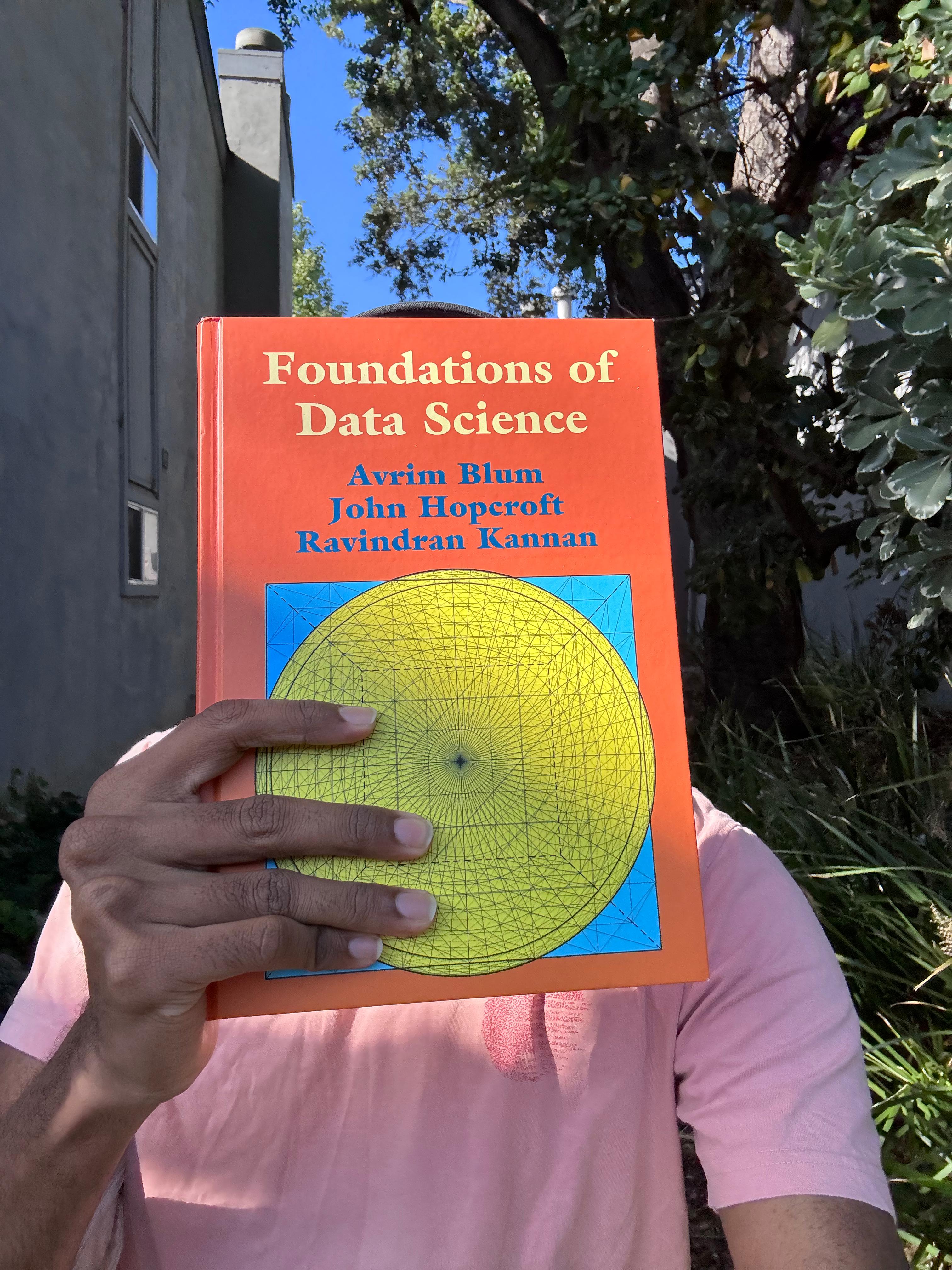
Math and science is a developing interest that has grown over time. I’ve been reading Foundations of Data Science by Blum, Hopcroft, and Kannan, and it’s giving me an edge — a way back into the nitty-gritty of high-dimensional statistics and the theoretical grain of things, which lets me hit problems from angles I otherwise wouldn’t. It has taught me something about method, too. When a new problem lands, the instinct shouldn’t be to reach first for whatever was published in a recent workshop. That halts original thinking. It’s better to reason from the established, seminal work, let your own understanding develop, and only then validate it against the literature — rather than scanning for a one- or two-percentage-point gap in someone’s recent paper and calling that a contribution. The same holds for engineering blogs and posts: let your own thinking choose the framework or design pattern first, then go to the references and to whatever LinkedIn is calling groundbreaking this week. The recent thing needs a gap. It needs time.
Design and human-centeredness is something that developed from my Captain Fresh days onward, whenever I got to work closely with product people and the owners of a problem. It’s the understanding that you don’t just push a workflow or a tool at people and tell them to use it. You make it something they can adopt seamlessly, give feedback on, and improve — you think from their side of it. The roots go back to the empathy maps we built at Mu Sigma. It was never about throwing models at a business; it was about developing real empathy for whoever owns the problem, or struggles with it — a team, a segment, a person. I want to keep building that muscle, through more design patterns and more prototypes.
Thinking, reading, and writing sits underneath all of it. Writing is the one I never treated as a craft to be learned — I just wrote the way I wished to convey a thing. But good writing has to be reader-centered and empathetic, and that’s precisely the skill I want to build. Lately I’ve been writing real letters and emails to people — a few friends, some near-strangers — trying to have conversations that actually go somewhere. The impulse came partly from two novels: Virginia Evans’s The Correspondent, built entirely out of one woman’s letters, and Allen Levi’s Theo of Golden, about a stranger who moves through a town collecting people’s stories one portrait at a time. Both are really about the same thing — seeing and being seen. There’s a distinction I keep coming back to, between résumé virtues and eulogy virtues, and I think the weight belongs on the eulogy virtues — connection built on who someone is, not on what they’ve accomplished. That lens keeps the focus where it should be — on the problem that’s actually affecting a system, a business, a group of people, or even something personal — rather than on the reflexive résumé move of throwing a quick “do this, read that” at a problem and moving on.
Why I don’t wait for anyone’s roadmap
There’s a conviction that sits underneath how I try to learn all of this, and it’s become sharper lately. Information isn’t scarce anymore. Knowledge isn’t costly. Anyone can open a coding assistant, spin up a repository, and treat it as a workbench — a place to curate the exact curriculum they want, with exercises, examples, quizzes, flashcards, whatever helps a thing finally click. Which is why the “comment AI and I’ll DM you the roadmap” genre bothers me. Gating knowledge behind engagement is disrespectful to the learner. If you have something useful, just give it. The steps that actually matter are the ones shaped to how a particular person wants to understand something — and that’s a thing you can now build for yourself, without waiting on anyone’s algorithm.
So where do I actually go instead? Mostly to scholarly sources — the personal websites and course pages of professors whose thinking I trust. Not a roadmap, not a recipe, but the fundamental mental models underneath: how someone frames a hard idea, how they’d climb into it, what they’d read alongside it. At Columbia I’ve learned as much from the shape of people’s work as from any single lecture — David Blei’s on probabilistic modeling and applied causality, Elias Bareinboim’s on the theoretical and algorithmic side of causal inference, Daniel Hsu’s on algorithmic statistics and the foundations of learning. Reading them side by side is its own education; the same territory framed three different ways teaches you more than any one framing can. And it isn’t only the papers — it’s the curated reading lists, the lecture notes, the slides, the offhand book recommendations you’d never stumble onto in a blog. A book like Chris Wiggins and Matthew Jones’s How Data Happened does something a survey paper can’t: it shows how a whole field became what it is — much as Tim Wu’s The Age of Extraction traces how platform power quietly reshaped the economy. So I follow course and lab pages the way other people follow feeds — Nakul Verma’s, Cliff Stein’s, Indika Rajapakse’s Mathematics of Data at Michigan, and lab sites across CMU, Berkeley, and Stanford — because a scholar’s evolving body of work is a far deeper thing than a course you take for one semester and forget. Courses are temporary. A carefully built way of thinking compounds.
The same conviction runs through how I think about teaching and community. I’ve been pitching an idea I call learning hearts — cross-school gatherings where students from very different backgrounds come together to present and discuss. Columbia’s Climate School was curious about it. Picture a climate data science student presenting to people from professional studies, engineering, journalism: everyone brings a different perspective, a different set of needs. That mix is hard to find anywhere else — inside a company everyone tends to think from the same product or business lens, and most outside gatherings are all technologists. So when I email people at the university, it isn’t only “can I TA or RA.” It’s often just sharing a thought that might help an institute think about something. I picture it as throwing a data point past the edge of a distribution: if a body of knowledge sits between minus two and plus two, a few points from outside that range can stretch what a community, an institution, or a single person is able to hold. That’s what I’m really after — triggering new interactions, extending the distribution, for others and for myself.
How do I choose what — and who — to work with?
There’s another trade-off running underneath all of this, and it took me a while to see it clearly: the difference between experimenting with an idea and experiencing it. I share a lot of my thinking online. Some of it I keep returning to; some I quietly let go. What that churn has taught me isn’t only intellectual — it isn’t just that some part of my brain now knows how to build a simulation. It’s that I’ve felt, from the inside, whether a given problem actually satisfies me, whether it gives me the sense that something real is being solved, or whether it’s pointing at something else entirely. Agent-based modeling and simulation was like that for me: I spent a long stretch prototyping, experimenting, talking with founders and people at behavioral labs. The value wasn’t the technique. It was learning how that problem felt — how interesting it was, how steep the curve, how much it demanded of me. There’s plenty of bias and distraction mixed into that kind of judgment, but none of it shows up on a résumé, and I’ve stopped trying to make it.
Which is also why I’ve made a kind of peace with something that used to bother me. I’d watch people join labs strategically, network with real intent, position themselves cleanly — and I’d wonder why I couldn’t seem to do the same, whether I was doing something wrong. The honest answer, I think, is just that the vibe and the thought process are different. I’m drawn to people who’d rather have a real conversation than trade résumés, and to work that rewards patience over positioning.
That’s the spirit of a collaboration I’ve been part of — with a PhD researcher at Columbia’s CRIS Lab, on something well outside my usual orbit. Not continual learning, not RAG, not memory, not agents. It sits at the intersection of system dynamics and machine learning, close to the discovery side of things. The progress is slow, and that’s exactly the point: we’re learning, trying things, letting the fundamentals settle in, rather than dropping a dataset into a model and calling it done. Slow, steady collaborations like that end up meaning far more to me than the fast ones.
And it extends past work, into how I want to be with people. The conversations I care about — with batchmates, old colleagues, friends — have almost nothing to do with jobs, course selection, or how to build a résumé. A friend starting a company and I trade messages that wander from the early history of decision analysis to design patterns to what actually makes a life engaging; he just became a father, so that’s in there too. With younger friends about to start at Columbia and NYU, what I most want to give them isn’t tactics — it’s hope, a head start, and permission to explore widely and learn something genuinely new. To one of them, a friend of more than a decade, I gave books like How to Build a Car and The Design of Everyday Things — less for the content than for the wings: new ways to think, instead of staying boxed in. And some of the best conversations arrive by accident. A stranger at a coffee shop saw me holding Rethinking Consciousness and we ended up talking for hours about subjective experience — why we feel anything at all, why the struggles of a human life take the shape they do.
Someone once told me I look at life a little too much like an engineer and a scientist, that I could add a pinch of empathy. I’ve sat with that. I don’t think what I’m short on is empathy, exactly — I think what I have is more optimism. When I tell someone not to worry, that they’ll find their way, that they’ll make it, I mean it, and I mean it as encouragement. But optimism offered without enough care for someone’s real constraints can read as though you haven’t fully understood them. So maybe the work there is to let the optimism carry a little more human-centeredness — to keep the hope, but hold it closer to where the other person actually stands.
What am I listening for?
Years ago, a VP asked me a simple question: do you want to solve some of the critical problems, or not? At the time it was almost a challenge. Now I understand it was the exact signal I’ve been listening for ever since — the kind of inbound that actually means something. Not a role, not a title. A question about whether you’re willing to sit with something hard for a long time.
So if any of this resonates — if you have a problem worth brewing on, and you’d rather share the journey of solving it than trade a checklist of credentials — that’s the ground I want to build on. That’s the state I’m in, and that’s what it’s for.
And the life around all of it
I should end by widening the lens, because if I stopped at the work I’d be misrepresenting myself. There’s a whole life around all of this, and it isn’t separate from the thinking — it’s where a lot of the thinking comes from.
When I’m not learning or coding or building, I’m usually cooking — curating a bowl, chasing a cuisine I haven’t tried — or simply watching. I’m writing this from a quiet street in downtown Los Altos: mild weather, big old trees, low buildings, good architecture, an old man ambling past with a small dog on a long rope, a kind of controlled, extended freedom. I do this everywhere I go. I watch people, streets, birds, and try to understand the patterns — not to judge them, but to place them on a map: how one city’s vibe differs from another’s, how a lifestyle quietly emerges. My mom has a Tamil word for it — rasanaikaran — roughly, someone with a real eye for beauty, alive to the aesthetic and creative grain of everyday life and ordinary things. I’ll tell you the food map of Tamil Nadu, or how a New York slice differs from one anywhere else, and I’ll happily admit I love pineapple on pizza — the Papa John’s version, specifically.
The savoring shows up in small rituals. When sleep won’t come at midnight, I open Instagram and post a story — never a random repost, but a sketch I’ve drawn, set to a song I’ve picked: a way of experiencing a thing rather than just consuming it. I’m drawn to slow, mindful creatures — beavers, otters, bears — and to children. Most of all my sister’s two-year-old, Leo Amizhdan — I named him with Tolstoy in mind. I’ve watched him go from a baby I could hold in two hands to a small person climbing doors and windows, learning to say “mama,” and starting to talk to me.
Is any of this empty — a distraction from the “real” work? I used to half-wonder. I don’t anymore. It’s coherent, it’s engaging, and it keeps carrying me to the next place in life. The same is true of the parts I’m still tending: taking better care of my body, and, in time, finding the right person to share all of it with. Those aren’t separate from the purpose. The perspective that tells me what I actually want, where I need to be, and how to be with people comes from exactly this — continuous experimenting and experiencing, in the kitchen and on the street as much as at the desk.
So: a calm Wednesday evening, a quiet street, a watch party for the match spilling out a block over. Thank you for reading this far — writing it has been its own kind of liberating. Let life be happier, and figure-out-able, and purposeful, and meaningful.