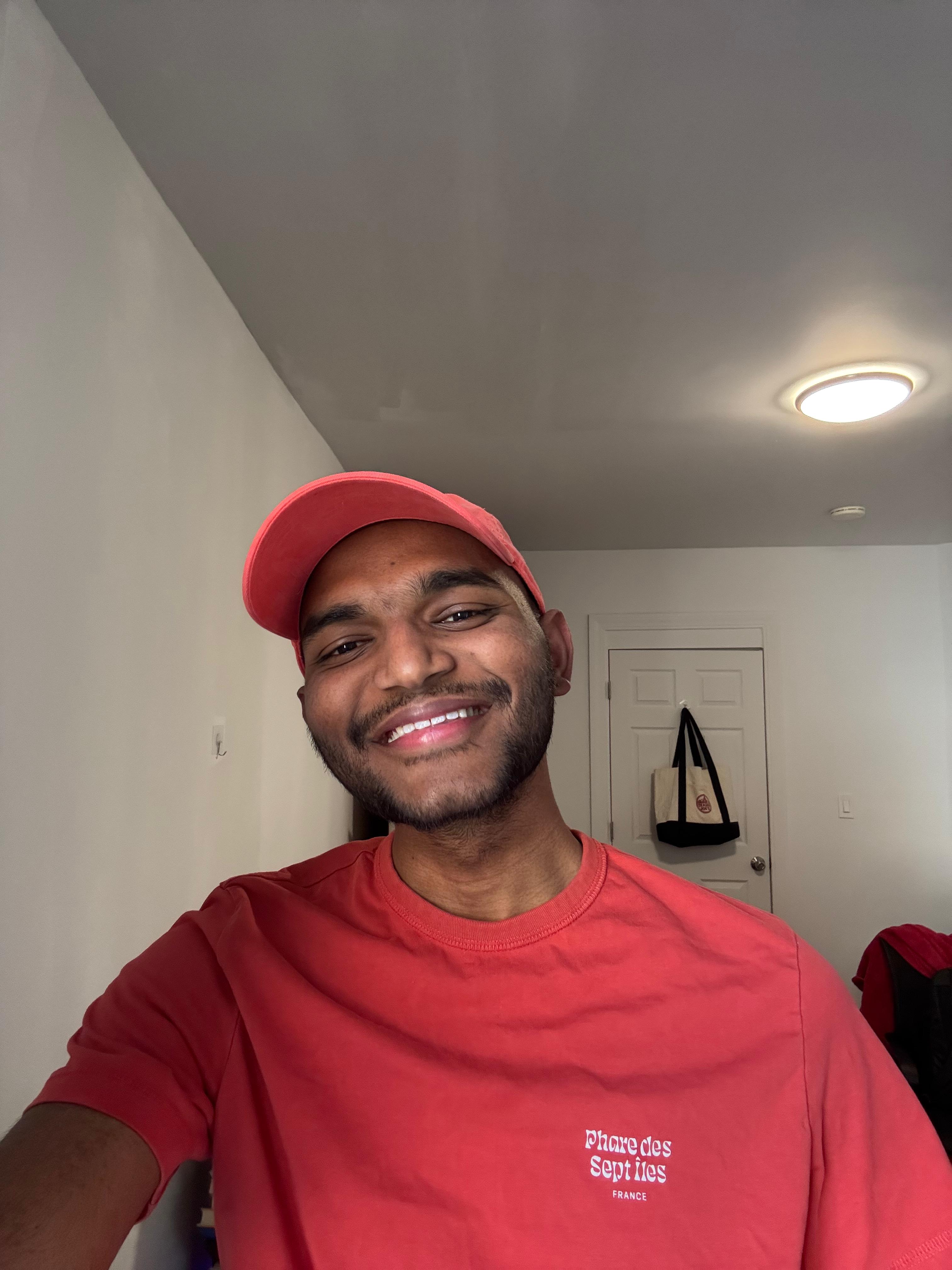
Prabakaran Chandran
பிரபாகரன் சந்திரன் · Tamil Nadu → New York
I chose control engineering somewhat by accident. My plus-two marks weren't what I needed for the top courses: mechanical, computer, triple E. Control engineering was offered in just seven colleges across Tamil Nadu. Less competition, I thought. Maybe I'd get a gold medal. That was the whole plan. It was naive. I didn't get the medal either. Health issues got in the way. But what I did get, without looking for it, was a lens. Control theory gives you something: everything is a system. Anything that can be seen as a system can be modeled, understood, acted upon. I've never stopped seeing the world that way.
Three things crystallized through that degree: systems, computation, and intelligence. Control systems and state-space models. Signal processing and soft computing: neural networks, genetic algorithms, evolutionary computing. Not deep, not research-level. But enough to kindle the interest and give me a frame. I didn't know it then, but that frame would organize everything that followed.
Then came Mu Sigma. Dheeraj and the whole complexity science orientation there aligned naturally with what I had already started building. Complexity, non-linearity, feedback, emergence, not just as engineering concepts but as a way of reading business problems and social systems. Over three years there, the frame kept widening: systems, behavior, intelligence. Behavior because when you model how people buy, how markets move, you're studying the behavioral aspects of social systems. Intelligence because that's what we were always pointing toward.
After that: Captain Fresh, Informatica, a stealth startup. Six-plus years of production ML systems: satellite imagery, aquaculture, document understanding, enterprise AI, agentic pipelines. I learned how to operate. I learned where the real friction is. I also noticed what I kept running into: the gap between knowing how to run a model and knowing why the model should work the way it does. Industry, under time pressure, lets you settle for "good enough." I stopped wanting to settle.
That's why I came to Columbia. MS in Data Science: reinforcement learning, , probabilistic modeling, dynamical systems. I'm also TA-ing in courses: Applied Risk Analytics, Causal Inference, Advanced Analytics, Statistical Analysis. The goal isn't to add credentials. The goal is to fill the gaps rigorously, to develop the theoretical foundation that makes my problem-solving genuinely different, not just experienced.
One month into the program I wrote about this: the metamorphosis. Unlearning the industry reflex to "just build a project" and learning instead to do the mathematical exercises, the derivations, the deliberate theoretical practice. A project should emerge as cumulative learning, not as a shortcut to something to show. That's a different way of working. I'm trusting it.
The discipline is concrete. , a self-designed and self-directed sprint-based research program, gives it structure: each sprint begins with a precisely defined question and ends with working code, a finding, or a documented failure. Four objectives serve as a loop rather than sequential stages: Discovery, Evidence, Inference, Optimization. The logic is the same everywhere, every sprint sharpens the next question, every result, positive or negative, is evidence.
The intellectual interests that organize all of it: AI, control science, and complexity science are not three separate tracks. They converge. Control gives you the language of state, dynamics, and feedback. Complexity science shows what happens when those go nonlinear: , adaptation, surprise. AI is the machinery that makes both tractable at scale. The destination they point to, naturally, is decisions and , how intelligent systems choose well in worlds that keep changing, and how new knowledge gets found when the map doesn’t match the territory.
What I believe in: . Not zero-order (pick a model from the list) or first-order (tune it and ship). The problems I care about don't have obvious algorithm choices. They require you to understand the system, formulate the problem correctly, think about mechanisms, not just fit to data. That's the direction.
I'm not chasing the usual signals. I know what I've built, I know what I'm building toward. Building is the mechanism of becoming, not building to show something, but building as the way the thinking gets real and the person gets formed. Each new idea worked on is a small act of self-construction. The work is what matters. Manhattan is temporary.