How Kavin Aravindhan Shaped His Career — From a Fresher to Advanced Master’s Research at Columbia | A Conversation
A Journey That Matters.
For a while now, I’ve been quietly collecting the stories of people I’ve crossed paths with on this master’s-and-machine-learning journey — what they learned, where they struggled, and the small, hard-won insights that rarely make it onto a LinkedIn timeline. This is the first one I’m writing down.
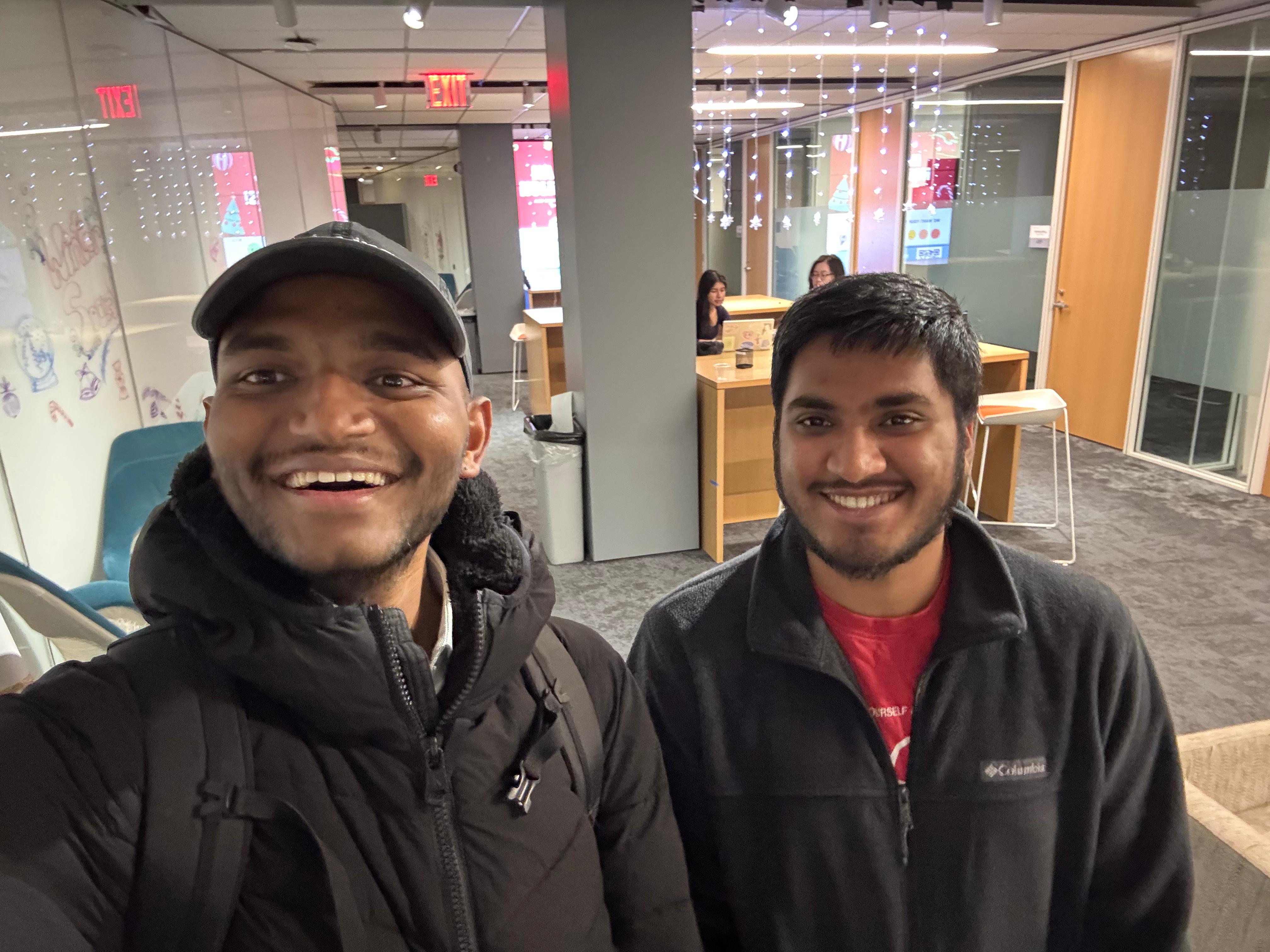
Kavin Aravindhan is my senior. He joined the MS in Computer Science at Columbia in August 2024 and graduated this May, in 2026. Over those twenty months he took a wide spread of courses, built projects, ran at hackathons, did TA and RA stints, served as an MS program chair on the student body, and then went a step further — staying one extra semester to do Advanced Master Research and submitting his work to a main conference. For the last year, since around May 2025, he’s been the person helping me find my own footing here at Columbia — which courses to think about, which opportunities matter, how the whole ecosystem actually works.
So when he graduated about ten days ago, we went to a café, ordered brunch, and just talked. What follows is most of that conversation. I’ve tried to keep it genuine rather than make it “viral” — Kavin himself is allergic to the performative version of these stories, and I think the honest one is far more useful anyway.
On feeling low, and the people who carry you
Q. Let me start somewhere unusual. When was the last time you felt really low — or emotional?
Kavin: I’m not really an overly emotional person. But I do feel low or disappointed sometimes. Early on, around welcome day in August 2024, I found myself missing someone who matters a lot to me. After that there were the usual waves of homesickness, and sometimes that quiet “what am I even doing here” feeling.
I’m from Chennai, in Tamil Nadu — I did my bachelor’s back home in Tamil Nadu before coming here. I’m a single child, so coming this far from home hits differently, even though I’d already lived in a hostel for years. What pulled me through was the community here. I got genuinely good friends, and that helped in more ways than I expected.
Q. How did the people around you — especially your friends — help you over the months?
Kavin: More than I can put into words. I had a small circle of close friends, and what I loved is that each of them brought a completely different temperament. One of them is incredibly kind and stays positive about everything — whatever hackathon or competition we threw ourselves at, she’d remind us not to worry too much, to go easy on the outcomes. Another is the studious, focused one who keeps you honest about the work. A couple of them are calm and composed — the ones telling you not to rush, not to make everything an emergency. And one is just deeply accommodating, a really good companion through the hard stretches. Between all those temperaments, there was always someone with exactly the perspective I needed on a given day.
The arc, looking back
Q. Looking back across the two years, what does the arc actually look like to you?
Kavin: To explain it I have to go back to undergrad. A lot of people around me weren’t exploring anything beyond landing a job. I always tried to push past that — going to hackathons, doing things that weren’t on the standard track. And because I was curious, faculty started backing me.
Coming to Columbia was a jump in every dimension. The level at which machine learning is taught here, compared to what I’d seen in private colleges back in Tamil Nadu, was on another scale. From my very first semester I was sitting in classes taught by people like Nakul Verma and Richard Zemel — machine learning, quantum computing, neural networks and deep learning, taught by some of the best in the world. The depth of fundamentals and the nuances I picked up were immense.
And here’s the part I still find moving: someone who grew up feeling there were “classes” of students based on background ended up getting to work with Professor Kathleen McKeown — one of the most respected names in NLP research, an ACL Lifetime Achievement awardee, and the founding director of Columbia’s Data Science Institute. Over the semesters I worked in labs as a research assistant and across programs as a TA and course assistant — on agentic AI platforms, biomedical computer vision, vision-language models, and computer graphics. And eventually I got into Advanced Master Research, which is very selective — you need a strong proposal and strong advocacy from professors to get in.
So the honest version of the arc is just consistency and persistence. There were failures and mistakes all through it. But I came out feeling genuinely ready to work on modern AI problems, and on the things I actually care about — vision and language models.
On research, and what it really is
Q. Tell me about research. How did your exposure grow, and how did the AMR actually come together?
Kavin: In undergrad, my whole exposure to research was IEEE papers and that sort of thing. Once I got here, I learned what the A* conferences really are. I’m drawn to NLP, computer vision, and vision-language models, and my lab had contributed a lot to venues like ACL and EMNLP, so I got a much sharper sense of what to focus on, what not to focus on, what matters, how to communicate it, and how to actually run experiments.
Learning directly from the PhD students and from the professor herself was the most valuable part. I kept good relationships with the PhD students, and that’s how I really understood paper-writing — enough to submit my own. A close friend of mine was doing AMR alongside me too, and having someone in the trenches with you changes everything; I learned a huge amount from him. Which is part of why I’d say: choose friends with broad, generous, helpful minds over people who are judgmental and closed off. It compounds.
Q. As you were doing the AMR — talking to more people, exploring more — how did your idea of what research is start to shift?
Kavin: The biggest shift was realizing it’s not about randomly joining a group just to get your name on a paper. That’s the easy, hollow version. What actually matters is being patient — waiting for the right moment, letting a genuinely good idea develop over time, and only then writing it up and submitting it. Not doing it just for the sake of having done it.
And the deeper point is that the research journey shouldn’t end at graduation. The mindset should be that you do research because you want to, at any point in your life — not for two lines on a résumé or to clear an interview. Honestly, most typical interviews don’t even probe it seriously. So it’s worth being mindful: do it because it’s the work you care about, not because of what it signals.
On networking and the job search
Q. How did your thinking about networking — and the whole job search — evolve over these two years?
Kavin: A lot. I came to see that the best networking grows out of actually having done things. When you’ve run real experiments and explored enough, you have genuine context — and that lets you talk to people across industries as a peer, not as someone making surface-level conversation. Walking in unprepared, without enough context, is what ruins those conversations.
I’d rather it be natural, built around ideas and thought processes, than performative chatter aimed at extracting a job or a referral. And I think connections should go beyond the transactional, beyond “is this person useful to me.” As students in the same community, we should be able to have open conversations, share how things actually work, and help each other. That part shouldn’t feel intimidating or calculated.
This is also why I stepped back from LinkedIn — I haven’t really used it for the last few months. It started to feel off: the timeline is wall-to-wall announcements, almost no real stories, learnings, or first-hand experience. Twitter felt like the opposite — people there are open about what they’re building, the messy intermediate steps, what they learned. I keep wondering why the norm became only posting updates, with so little of the real story behind them.
And it all loops back to doing real work. Building things beyond your assignments and coursework is exactly what gives you something honest to share — then any connection becomes easy, because you can just say, “here’s what I built, here’s how it actually went.” So if you do want to focus on the job hunt: don’t apply blindly. Keep a tight list of specific companies, do the networking, really understand each role, and build projects that map to those roles — rather than spraying applications everywhere and keeping everything scattered.
On professors
Q. How important was building a good rapport with professors?
Kavin: Genuinely important — not just for advice and knowledge, but for moral support. And it’s also how you get the full student-life experience. A lot of master’s students miss this. They pour everything into hackathons and job prep and never really develop a relationship with their classes or their professors — and they lose something real in the process.
What he’d tell the juniors
Q. If you could go back to your first months, what would you do differently — and what would you tell the juniors coming in after you?
Kavin: It’s the same answer, really: don’t rush, and don’t chase things just for the sake of chasing them. When I arrived, I was caught in the hype — I have to get a TA position, I have to get into that lab, I have to take these exact courses. My first semester was overwhelming because of it. I course-corrected from the second semester onward.
That fear of missing out, the pull of whatever the crowd collectively believes is important — it’s loud, and it almost never lines up with what you’re genuinely interested in. Give yourself space. Give yourself time to actually go through things and notice what’s working and what isn’t. And keep exploration alive. So many people lock onto one linear roadmap — “I just need a job, I won’t look at anything else” — and I’d push the opposite.
The other thing I’d tell juniors: stop looking for a playbook. I’m honestly a little tired of how much people fixate on “tell me exactly what to do” instead of exploring, trying, and learning from the outcomes — including the failures. For a long-term career, that journey is the point. It’s far more valuable than compromising your coursework and your actual learning just to keep your head down for interview prep and keep everything linear and safe and a bit cliché. Copying someone else’s exact path doesn’t serve you in the long run — it just narrows how you think.
What feels unique about the path
Q. Compared to your friends at other universities, what feels unique about your path?
Kavin: Two things. First, I took courses that are very specifically AI — a whole series like High Performance Machine Learning, scaling, LLMs — and did projects across language models and a lot of adjacent areas. So I explored a wide cross-section of AI deeply. My friends at some other universities tended to do less in the curriculum itself and more in hackathons and job prep. My bet is that the research experience plus the coursework will let me adapt to almost anything that comes next.
Second, the ecosystem here is genuinely open — you can do whatever you set your mind to. Getting into a lab and doing real work is mostly a matter of time and effort, because there are world-class professors across systems, theory, ML, computer vision, reinforcement learning — you name it. For my background and the arc I was on, that openness made all the difference.
And it’s not just within engineering. You can collaborate with people across schools and work on genuinely interdisciplinary ideas — participating in things, and even winning, alongside students from SPS, SIPA, or CBS is a very different kind of learning experience. The mix of backgrounds in the room changes how you think. The same goes for research: as a SEAS student you can take on problems coming out of completely different schools — the Columbia Irving Medical Center, the Climate School, the Law School, Barnard, and so on. That cross-pollination is one of the most underrated parts of being here, and most people never tap it.
The next three to five years
Q. Last one. Where do you see yourself in the next three to five years?
Kavin: Two possible versions. One is being a research engineer at an AI-research-focused startup — or being an instrumental, founding-engineer kind of figure in something of my own. The other is going back to do a PhD, after I’ve gained enough work experience.
For now, with the energy I have, I want to be in New York and explore — I love the vibe and the pace of this city. But I also discovered during my internship in New Hampshire how much I love calm places and trekking, so I want room for both. Even if I landed a fully remote job, I’d still base myself here. It’s more energetic than the alternatives, and even just for hanging out and relaxing, the options are better.
A note of thanks
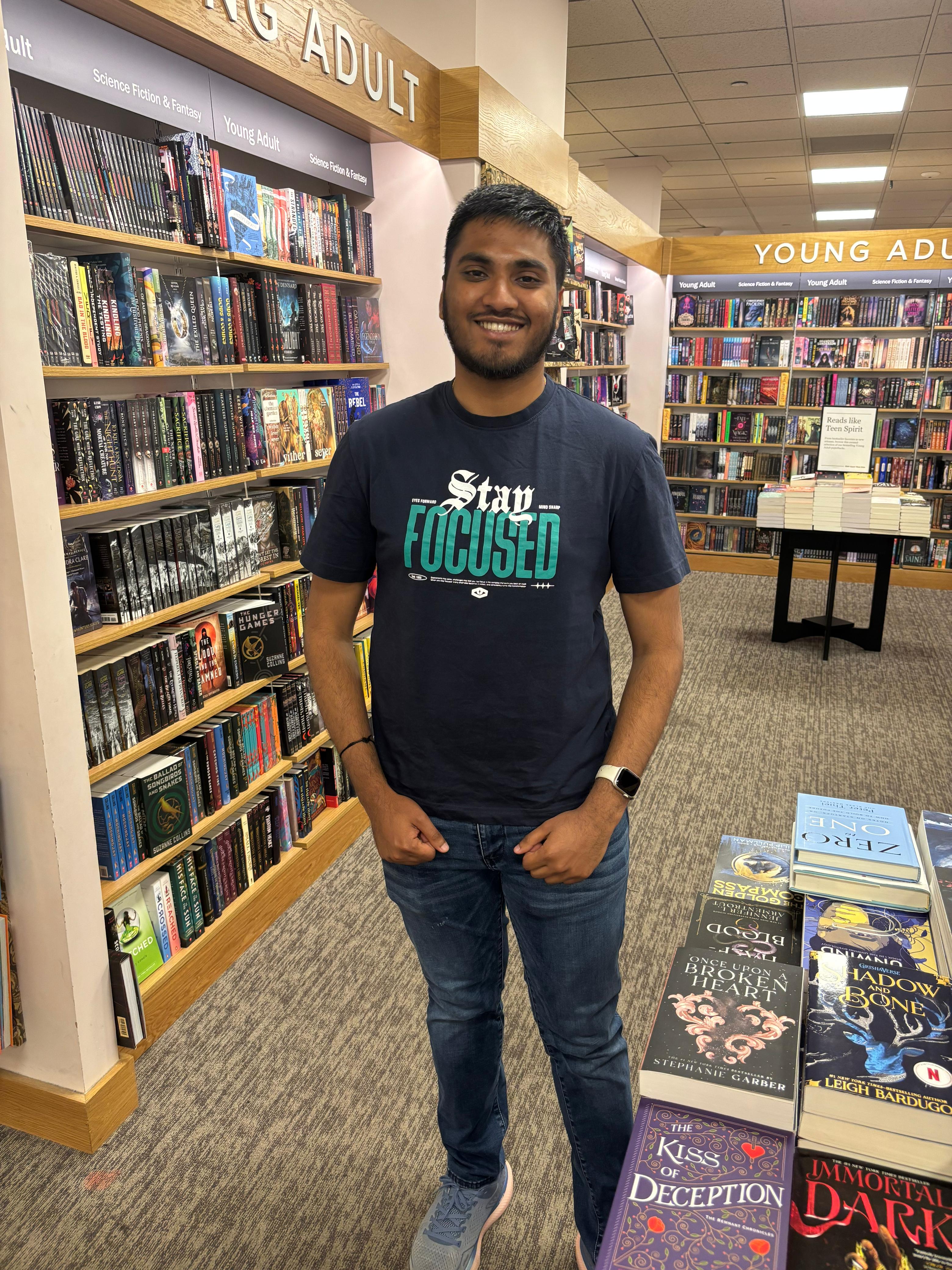
Kavin, thank you — for the last year of steady support in helping me find my way through Columbia, for sitting down and sharing your journey so openly, and for being so generous with so many people across departments who’ve leaned on you the way I have. You made a hard adjustment a lot less lonely for a lot of us.
Congratulations on everything you’ve built here, and on the road ahead. I have no doubt the next chapter will be even better than this one.
And to everyone reading — I hope some part of this is useful to you, wherever you are on your own path.