Daybook, 10 July 2026

A month into the internship, and the picture is clarifying. What started as “build some agents” has widened into building an end-to-end, enterprise-grade AI platform — and the freedom to shape it is where the real learning is. Three threads keep surfacing, and they keep converging.
A note on how that actually happens: in an enterprise, research doesn't start from “here's a dataset, go find a problem.” You build the system, and the real problems — and the research questions — emerge from the building. The more I build and iterate on what I'm actually handed, the more scope I find for genuine experiments.
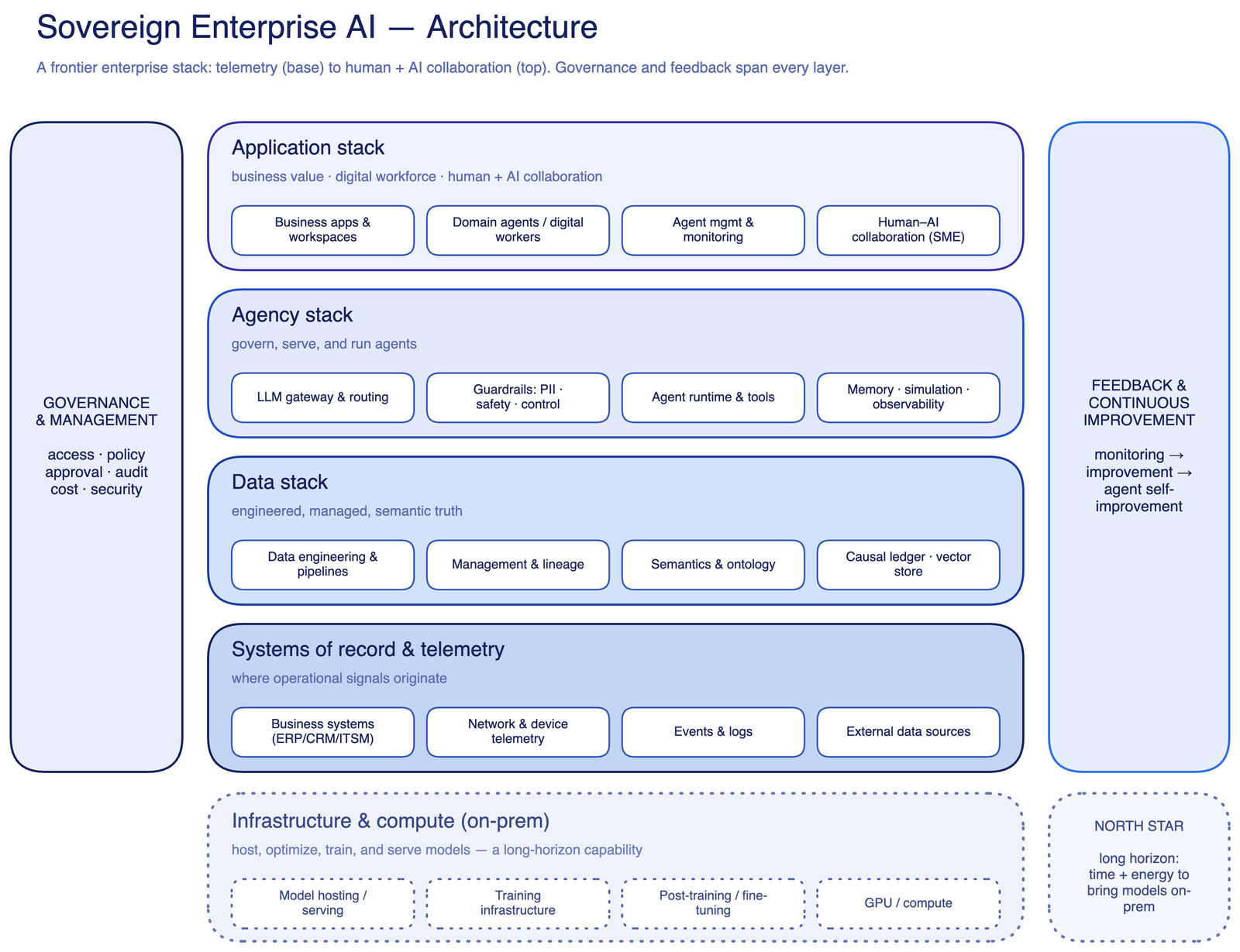
1 · Frontier, AI-native systems. Systems that fuse data, agents, applications, and human–AI collaboration — and, in time, self-improvement. Take an agentic system apart, component by component, and go deep on the questions inside each: agent evaluation, on-policy distillation, agentic RL. This is the enterprise-platform frontier — the shape of OpenAI Frontier and forward-deployed engineering, and of Palantir's sovereign-AI stance, that this is long-horizon institutional work, not a demo. It lines up with my internship, and with Stanford's CS153.
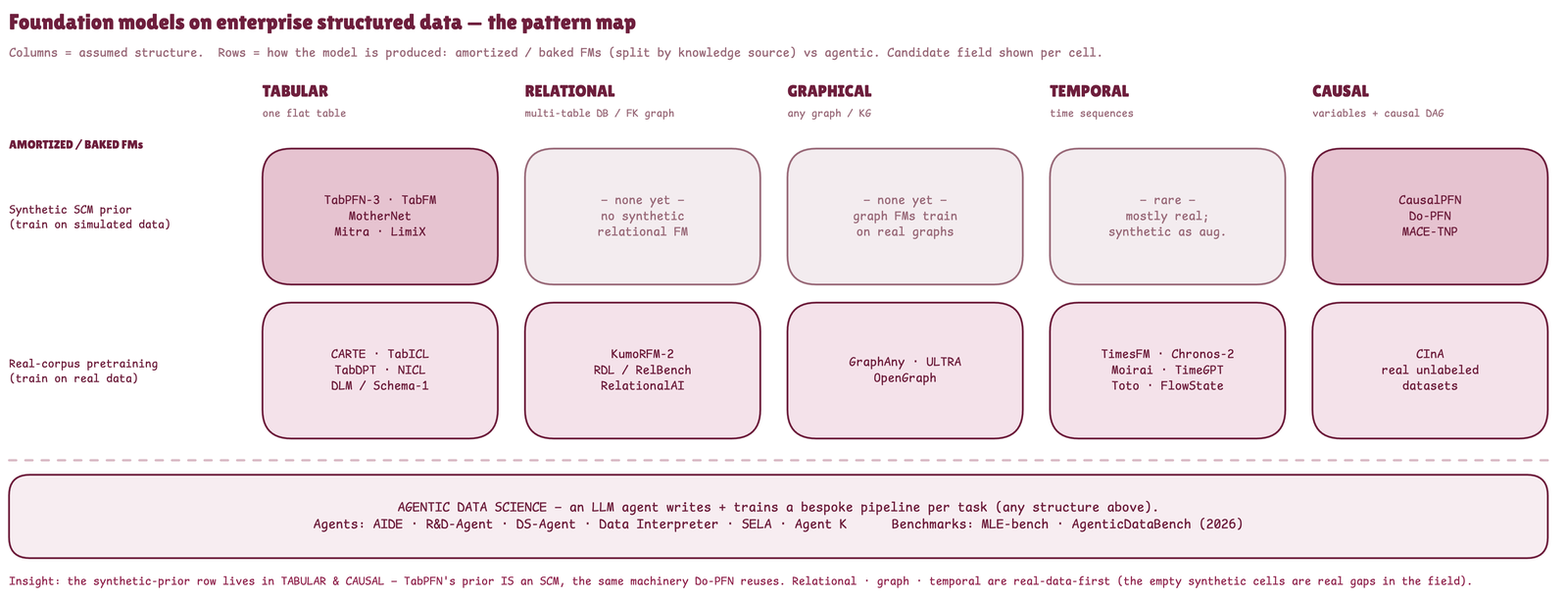
2 · Foundation models on enterprise / structured data. The long-shot question — and the one I wrote about in my MS statement of purpose: how do enterprises actually build and use foundation models on their structured data — not just RAG over documents — to solve a whole series of problems: customer churn, lifetime value, causal / treatment-effect estimation, anomaly detection? Two moves are converging: (a) foundation models for structured data — tabular, time-series, relational FMs — and (b) agentic systems for the data-science and analytics-engineering work itself. I'm handling data at every scale right now, from telemetry to transactions, so it's the right moment to actually experiment.
3 · Decision and planning quality — the missing piece. Here's the gap I keep hitting. Building agent workflows for data-science and ML work is fine, but on its own it doesn't bring in the planning and decision analysis these problems actually demand. FP&A, supply-chain planning, revenue-growth management, marketing optimization, life sciences — none of these is “wire up some context engineering and skills and ship.” They have to be designed and validated so that decision quality and planning quality are measured and evaluated — which is really just the fundamentals of decision science, resurfacing. This is why Kambhampati's LLM-Modulo framing lands for me: LLMs don't plan on their own; they help planning when they're wrapped in real verification. So the slow open thread is a benchmark for exactly this — can an agentic system build models, work the data, reason statistically and analytically, and produce a plan whose quality you can actually score?
The bet is that the three converge: a frontier, AI-native system, running foundation models over structured enterprise data, held to a real standard of decision and planning quality. That intersection is more or less my decision-engineering thesis, arriving from the other direction. On the side, half an hour at a time, I'm reading Anthropic's work on interfaces for human agency, and sketching decision-engineering use cases — meant to compound, not to finish.
Next: a weekend deep-dive on structured-data FM architectures, training recipes, and use cases, and a 4-hour session on AI-engineering components and design patterns. I'll keep attaching what I learn and build here.
Settled · 10 Jul 2026
Disagree, or know something I missed? Write to mepc3197@columbia.edu · the title goes in the subject line
Related
- Perspectives on Problemssessionphilosophy · science
- The Art of Problem Solving in the Age of Superintelligencecourseunder wayphilosophy · science
- AI Safety, Alignment, Human & AI Systems, Evals, Diffusion and Futurescourseplannedphilosophy · science